Top ERP Solutions for Food Processing Production Scheduling

Author
Vignesh R
6 min read
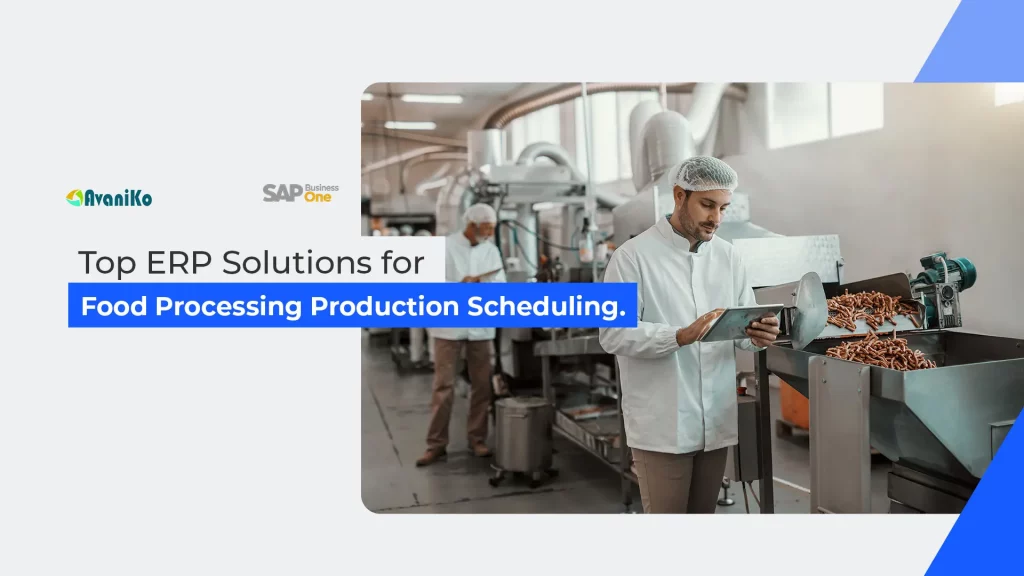
The food processing industry in India is undergoing a massive digital transformation. With the Ministry of Food Processing Industries (MoFPI) pushing for modernization and the implementation of stricter FSSAI regulations, local manufacturers can no longer rely on manual spreadsheets. Efficiency, traceability, and compliance are now the pillars of success.
Choosing the right ERP software for food processing is a strategic move that can streamline your supply chain, manage perishable inventory, and ensure food safety.
Why Food Processing Needs Specialized ERP
Generic ERPs often fail to address the nuances of the food industry, such as shelf life management, catch weight calculation, and formula secrecy. In India’s unique landscape-marked by fragmented supply chains and varying climate conditions-a robust system is essential.
Key Features to Look For:
- Recipe and formula management: Scalable production based on ingredient availability.
- Traceability: Bidirectional tracking from farm to fork for quick recalls.
- Quality Control (QC): Automated checks at various stages of production.
- Compliance: Built-in GST and FSSAI reporting capabilities.
Best ERP Software for Food Processing in India
1.SAP Business One (Food & Beverage Edition)
SAP remains a global leader, but its “Business One” version is specifically tailored for SMEs in India. It offers a comprehensive module for the food industry that handles everything from procurement to distribution.
Pros: High scalability and excellent integration with global supply chains.
Focus: Largescale processors looking for international standardization.
2.Microsoft Dynamics 365 (Business Central)
Dynamics 365 provides an incredibly flexible cloud based solution. The ability to integrate with the entire Microsoft ecosystem is its strength, which makes it easy for staff to adopt.
Pros: Real-time data analytics and powerful AI-driven demand forecasting.
Focus: Mid to large enterprises prioritizing data driven decision-making.
3.TallyPrime (with Customizations)
While traditionally an accounting software, many small-scale Indian food processors use Tally Prime with customized industry specific modules. The entry point for local compliance is the most economical.
Pros: Easy to find trained operators and excellent GST handling.
Focus: Small businesses and startups.
Comparison of Top ERP Solutions
| ERP Solution | Best For | Deployment | Compliance Focus |
|---|---|---|---|
| SAP Business One | SMBs | On-Premise / Cloud | Global and FSSAI |
| MS Dynamics 365 | Mid Market | Cloud | Modern Standards |
| NetSuite | Multi-location | Cloud | Export / Import |
| Batch Master | Process Focused | Hybrid | Quality & Safety |
| Tally Prime | Small Business | On-Premise | GST / Taxation |
Overcoming Implementation Challenges in India
Implementing an ERP in an Indian food processing plant comes with unique hurdles. You must consider:
- User Adoption: Ensure the UI is intuitive for floor staff who may not be tech savvy.
- To use cloud ERPs, make sure your processing unit has stable connectivity or opt for a hybrid model.
- Data Migration: Cleaning old records of vendors and raw materials is crucial before going live.
- To expedite troubleshooting, choose a vendor with a strong support presence in India.
Implementing an ERP is a significant business transformation. For food processors in India, the stakes are higher due to thin margins, perishable goods, and strict FSSAI compliance.
Phase 1: Pre-Implementation & Strategic Planning
Before looking at screens, look at your processes.
Identify Core Objectives: Define what success looks like (e.g., 20% reduction in waste, 100% batch traceability, or faster GST filing).
Form a Cross-Functional Team: Include Power Users from Production, QC, Finance, and Warehouse.
Map Current Workflows: Document exactly how an order moves from raw material receipt to final dispatch.
Budget Beyond the License: Account for hardware upgrades, training hours, data cleaning, and post-go-live support.
Phase 2: System Design & Configuration
Tailoring the software to your unique “secret sauce.”
Recipe/Formula Management: Set up Master BOMs (Bill of Materials) with version control to prevent unauthorized changes.
Traceability Setup: Configure automated Batch/Lot numbering for both raw materials and finished goods.
FSSAI & Regulatory Alignment: Ensure the system generates mandatory compliance reports (e.g., Form E, recall logs).
Quality Control (QC) Gates: Define mandatory inspection points where the system “locks” stock until a quality manager approves it.
Phase 3: Data Migration & Integration
The most critical and often underestimated phase.
⦁ Data Cleansing: Remove duplicate vendors, obsolete SKUs, and incorrect unit measurements from your old records.
⦁ Inventory “Cut-off”: Perform a physical stock count to ensure the opening balance in the ERP is 100% accurate.
⦁ Hardware Integration: Connect the ERP to weighing scales, barcode scanners, and thermal printers on the shop floor.
⦁ API Connections: Ensure the ERP speaks to your bank for payments or e-way bill portals for logistics.
Phase 4: Testing & User Training
Ensure the human element is ready for the change.
⦁ User Acceptance Testing (UAT): Have your floor staff run mock production days in the system to find bottlenecks.
⦁ Scenario Testing: Simulate a Mock Recall to see if the system can trace a contaminated batch in under 30 minutes.
⦁ Role-Specific Training: Don’t give everyone a general demo. Train the warehouse team on scanning and the finance team on reconciliation.
⦁ SOP Documentation: Create simple, localized “Cheat Sheets” for staff to reference at their workstations.
Phase 5: Go-Live & Post-Implementation
Transitioning to your New Normal.
⦁ The Big Bang or Phased Rollout: Decide if you will flip the switch all at once or module-by-module.
⦁ On-Site Support: Have your IT partner or internal “Power Users” physically present on the floor during the first week.
⦁ Weekly Review Meetings: For the first 90 days, meet weekly to resolve data entry errors and optimize slow processes.
⦁ Continuous Improvement: Once stable, begin utilizing advanced features like AI-based demand forecasting.
The ROI of ERP in Food Processing
Investing in a specialized system isn’t just an expense; it’s an efficiency gain. Companies typically see a 20% reduction in waste and a 15% improvement in production speed within the first year. By automating the “Expiry Date” alerts, you prevent the loss of raw materials, which directly impacts your bottom line.
In the food industry, data is as perishable as the product itself. If you can’t see your inventory levels in real-time, you are losing money every hour.”
Conclusion
Selecting the best ERP software for your food processing company in India depends on your scale, budget, and specific product line. Whether you choose the robustness of SAP, the flexibility of Dynamics 365, the goal remains the same: total control over your production lifecycle.
In 2026, staying competitive means moving away from guesswork and toward data work. Digitalizing your operations today ensures that you stay compliant with tomorrow’s regulations while meeting the growing demands of the Indian consumer market.